
01
Publish your own programmes
Your exercise selection, your structure, your set counts and your repetition ranges, published once and run by every client who buys it.
Founding creator programme
Write the programme. Cairn will not rewrite it. It makes the one decision you cannot make for every client on every set — what weight they should use today — from what they actually logged, by rules you can read.
The proposed founding partner offer
These are the terms we intend to launch with. They are a proposal, not a contract — we will put the final terms in writing before you publish anything.
01
Your exercise selection, your structure, your set counts and your repetition ranges, published once and run by every client who buys it.
02
A creator programme is a one-off purchase, priced by you within the range the app stores allow.
03
You retain the majority share of the net receipts from your programme sales — net meaning after Apple's or Google's commission, which is taken before either of us is paid.
04
Where a client you referred takes out Cairn Premium, we intend to pay you a recurring commission for as long as that subscription runs.
05
Cairn does not rotate your exercises, rewrite your repetition ranges or change your split. You decide which progression decisions it is permitted to personalise.
06
Under the founding partner offer there is no upfront publishing fee and no exclusivity. Your programme can exist elsewhere too.
A published programme is a product, not a client list. Buying it gives someone your programming and Cairn's progression — it does not oblige you to coach them individually, and it does not give you access to their training data. If you want a coaching relationship with someone, that is a separate thing, and it is described further down this page.
How it works for your client
This part is not a plan. It is the engine that ships in Cairn: Form today, and it is what your programme would be handed to.
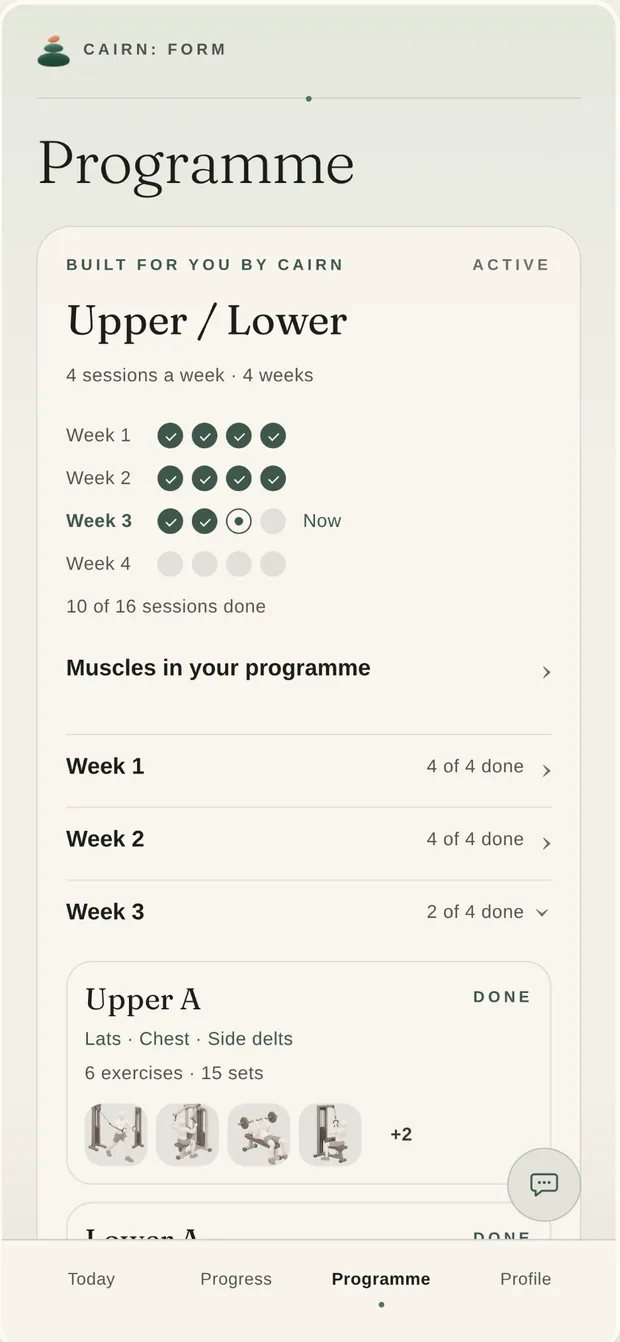
Exercises, order, sets and repetition ranges come from you. Cairn runs them for four weeks at a time.
It never invents a starting weight. For an exercise it has not seen the client lift, it declines to guess and settles the load over their first exposures from what they actually do.
Each session's offer comes from the sets they logged against your target range — not a fixed weekly increase, and not a percentage of a maximum Cairn has never measured.
At the four-week boundary it reads the whole block and carries your structure into the successor, with the loads where the evidence put them.
Each change carries a reason from a closed list, with the evidence behind it. "It just went up" is not an answer Cairn is capable of giving.
Before you ask
We would rather lose you on this page than three weeks after you publish.
| The worry | The answer |
|---|---|
| "An AI will rewrite my programming." | No programming decision in Cairn involves a model. The engine makes no inference calls and no network calls at all. The only AI is the in-app coach, and it is structurally unable to write a prescription. |
| "It will swap my exercises for variety." | There is no exercise rotation path in the engine. Where a lift has been flat across two blocks, Cairn offers the client an alternative and they decide. Dismissing the offer silences it. |
| "It will add volume because someone had a good month." | Progressing is the reason the volume is already correct — that check returns before any other. Set counts move only after a muscle has stalled across two consecutive blocks, by one set, and only on real adherence. |
| "It will drop their weights after one bad day." | A shortfall counts only if the repetitions were missed and the effort was genuinely hard. A missed session advances nothing in either direction. |
| "I programme in percentages of 1RM." | Then Cairn cannot express your programme today. There is no one-rep max anywhere in the engine, and we are not going to pretend otherwise. |
| "I need a specific effort or rest on my top set." | Not today. An authored programme carries your exercises, sets and repetition ranges; effort and rest come from Cairn's own table. Making those the coach's is on the roadmap and is not built yet. |
| "My programme is week 1 heavy, week 2 light." | Cairn runs a repeating week for four weeks and decides load per session. A week-by-week undulating template cannot be expressed today. |
| "Can I manage my roster in it?" | No — not today, and not partially. There is no coach view, no client list and no shared training data. See the coaching workspace below, and note what it is labelled. |
Set counts can move by one per muscle per block, where that muscle has stalled across two consecutive blocks on more than one of the movements that train it. Making that a contractual lock you control is planned. Today it is honest to say it can happen, and that your client can see it when it does.
Everything in this section is in development and none of it is available today. It is here so you can see where we are going, not so you can plan around it. Each capability depends on training data reaching a server, which it currently does not: all training data in Cairn lives on the client's own device.
A roster of the clients you coach, with the programme each one is running.
Write or revise a programme and send it to a client without sitting beside them.
What they completed, what they missed, and how their lifts are moving — with their consent.
Log a session on a client's behalf into their one training history, not a parallel coach record.
Decide which progression decisions Cairn may make for your client, and which need you.
Review what Cairn proposes at a block boundary, and approve, modify or reject it.
Sitting with a client, you can author their programme in their own app — your exercises, your order, your sets, your ranges — and let Cairn run it four weeks at a time, calibrating and progressing the loads you did not specify. Edits you make later are recorded and carried into every following block. That works now.
Applications
Tell us about your coaching and what you would want to publish. We read every application and reply personally — it is a conversation, not a queue.